
The Mind-Altering Effect of Carrying (and Using the Heck Out of) a Pocket Journal
I went from using a regular A5 journal to a pocket journal the size of my phone. This small difference is slowly reshaping my thought process.

“My ideas usually come not at my desk, but in the midst of living. A notebook is the only way to catch them.” — Virginia Woolf
I’d Like Some More, Please
I’ve been an avid journaler for years. Not a day has gone by that I have not emptied my head onto a page and experienced profound relief and/or insight. I’ve sung the praises of regular journaling many times over, so I won’t beat that dead horse here.
No, this short piece is uniquely about how carrying and using a pocket journal, aka pocket notebook, can positively alter your mind.
What I Mean By a Pocket Journal
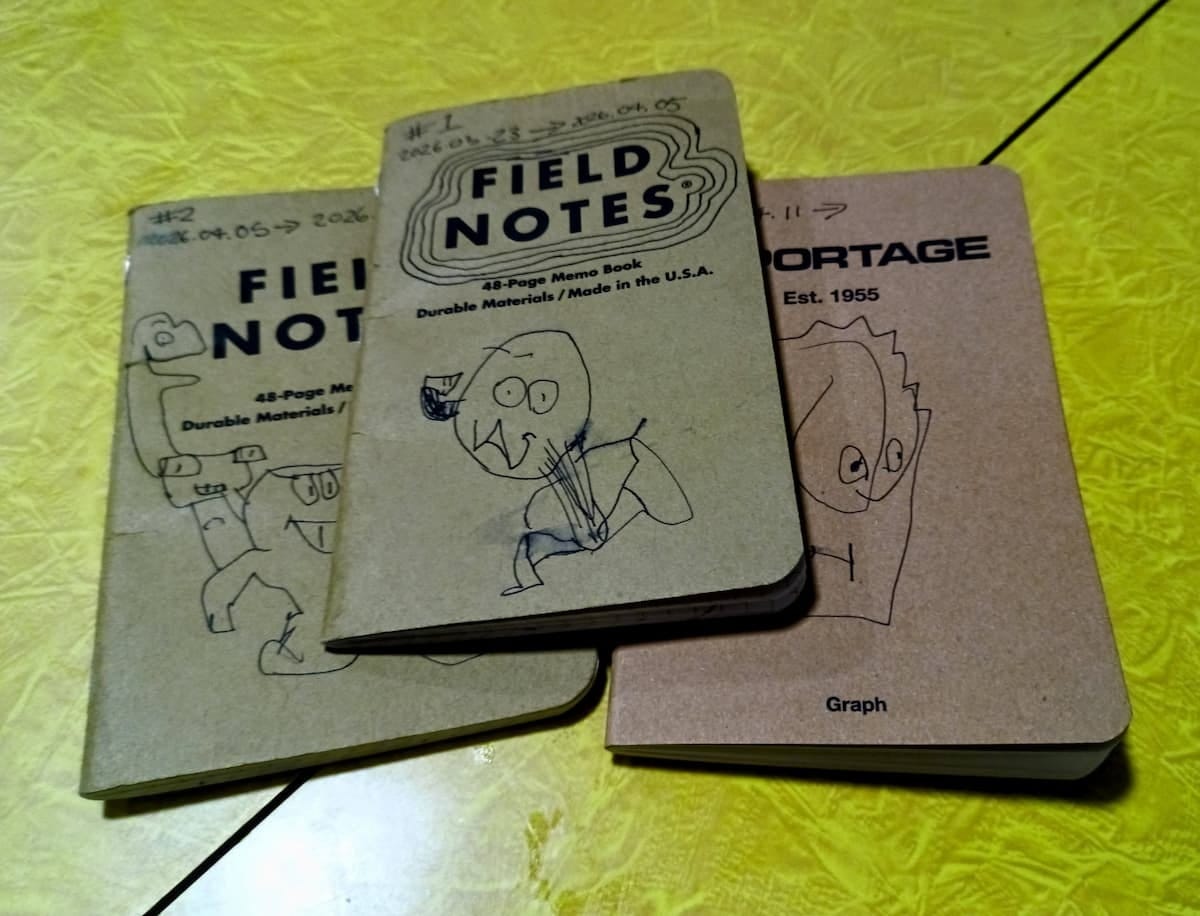
When I say “pocket journal,” I mean any comfortably pocketable notebook. I personally prefer a soft-covered 3.5” x 5.5” notebook with between 48–60 pages, but anything comfortable works.
Why I Started
I replaced my less pocketable A5 Moleskine-style journal with 3.5” x 5.5” notebooks for the sake of quick and frequent accessibility. Too often, I found myself out and about when the urge to scribble something down would strike with no journal present. Since then, I’ve rarely walked ten paces without a notebook and pen ready on the draw.
If this sounds like something you’d like to explore, here are five realizations you may experience.
1. Any thought can be captured. Any idea can be fleshed out. Any problem can be better defined.
“A notebook is a place to be messy, to experiment and to find your voice without the world watching.” — Austin Kleon, author of Steal Like an Artist
A pocketable notebook can be equal parts vault and workshop. Feel free to capture both the best and worst ideas and then scrutinize, repair, revise, or abandon them. Develop, demolish, reshape, stress-test, or just store an idea, thought, problem, or resolution—no matter how big or small, serious or silly.
2. Your notebook wants nothing from you.
I can hear many thinking the same thing: why can’t my phone do the same thing—only better?
And you’re right—a phone app can capture anything a notebook can, and it can recall it again years later with a few search terms.
But let me know if the following has ever happened to you:
You have an idea or thought you want to capture.
You pull out your phone and fire up the screen.
Suddenly, you’re lost in your email inbox, checking the weather, or tumbling head over feet down an array of feeds, each calling out to you.
The idea is gone along with 15 or more minutes, and you can’t get either back.
This isn’t your fault. Phones are well-crafted attention traps. Your eyeballs and thumbs keep the lights on for untold numbers of business entities. We don’t stand a chance.
A notebook’s only job, however, is to be a good notebook. It won’t distract you or lead you astray. As long as you keep it as close to you as you keep your phone, it will be capable of doing its job. Unlike your phone, you own everything about your notebook.
3. You will begin to break your addiction to consumption.
“Nothing is better proof of a well-ordered mind than a man’s ability to stop just where he is and pass some time in his own company.” — Seneca
We’ve become a people whose most immediate fear is boredom—a sensation in which even outrage and disgust have become preferred. To soothe this fear and get the monkey off of our back, a world of input awaits.
Having immediate access to the most alluring media ever designed, which has also been carefully curated to every preference, means we live in a state of perpetually heightened engagement—a ride we can never get off.
Alternatively, reaching for a simple notebook instead of a glowing magical mirror means choosing output over input. We’re opting to spend quality time with our own minds over receiving another hit of outrage or another bump of novelty. Over time, each reach for the notebook over the phone is a vote for intentionality and methodical slowness over a quick, numbing shot of digital dopamine. And they’re roughly the same size.
4. A notebook is infinitely useful.
“The notebook is a storage system for the mind’s loose change.” — Bruce Lee
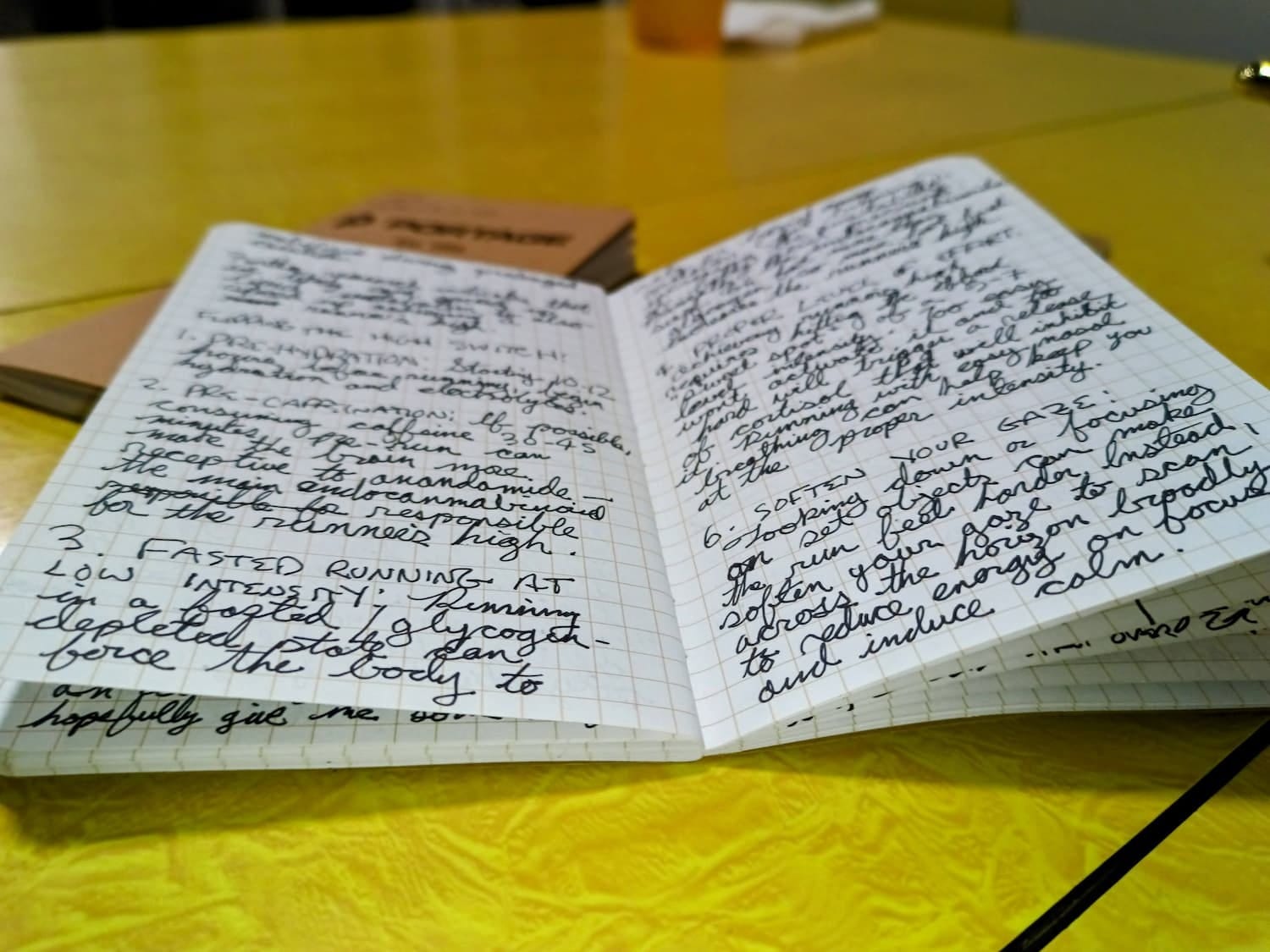
Up until this point, we’ve mainly discussed these notebooks as journals for collecting and processing thoughts. However, pocket notebooks can also quickly store to-do lists, grocery shopping lists, or contact details. Quickly tear out a page to leave a quick note behind after dinging someone’s car door. Pocket notebooks can also serve as anything from doorstops to drink coasters.
Yes, while a notebook can be the ultimate tool for capturing a literary masterpiece or analyzing your deepest thoughts, it can also keep a cafe table from wobbling.
5. Handwriting your thoughts on paper just feels good.
“The notebook is a sanctuary. It is the only place where the ‘undo’ button doesn’t exist, forcing you to own your mistakes and move forward.” — Ryder Carroll, creator of the Bullet Journal.
When it comes to the process of analyzing thoughts and deeply exploring profound concepts, the science backs handwriting every time. Research shows that handwriting slows down how we process information and better mentally organize experiences when journaling.
All of that aside, chewing on a thought, idea, or problem far from distracting screens just feels better than doing so before the judgment of a blinking cursor. Writing with a smooth-writing pen, ideally surrounded by nature (or at least nature-adjacent), can be one of the most quietly satisfying experiences a person can have. This is so much the case that I wrote the entire first draft of this piece in a 3.5” x 5.5” pocket notebook on my front porch.
I consider such an experience exponentially more satisfying than pecking my thoughts away in real time into a laptop’s keyboard.
Conclusion: Just give it a try. You have nothing to lose.
I think I’ve said all that I can say about the potentially life-changing benefits of simply keeping a pocket notebook and pen with you—really just as much as you already keep your phone with you. And good news—the notebook will likely take up less space (and never needs recharging).
GO FORTH AND JOURNAL IN THE WILD.
APPENDIX / ADDITIONAL RESOURCES
HOW TO USE
A. Got an interesting thought, idea, problem, or plan? Write about it. Have nothing to write about? Write about that. Stretch it out. Pull it apart. Chop it up. Assess your thinking about it. Leave it behind and re-read what you wrote about it later after your brain has had time to chew on it in the background. The only rule is that there are no rules. It is your journal.
B. Have some downtime where you have to wait? Instead of reaching for your phone, spend some time with your notebook. Execute the above “A” section. Jot down any stray tasks you’ve been meaning to tame. Develop a plan of action. Make a list of historical figures with whom you would like to share a hot air balloon ride. Simply unload your brain. Go absolutely crazy.
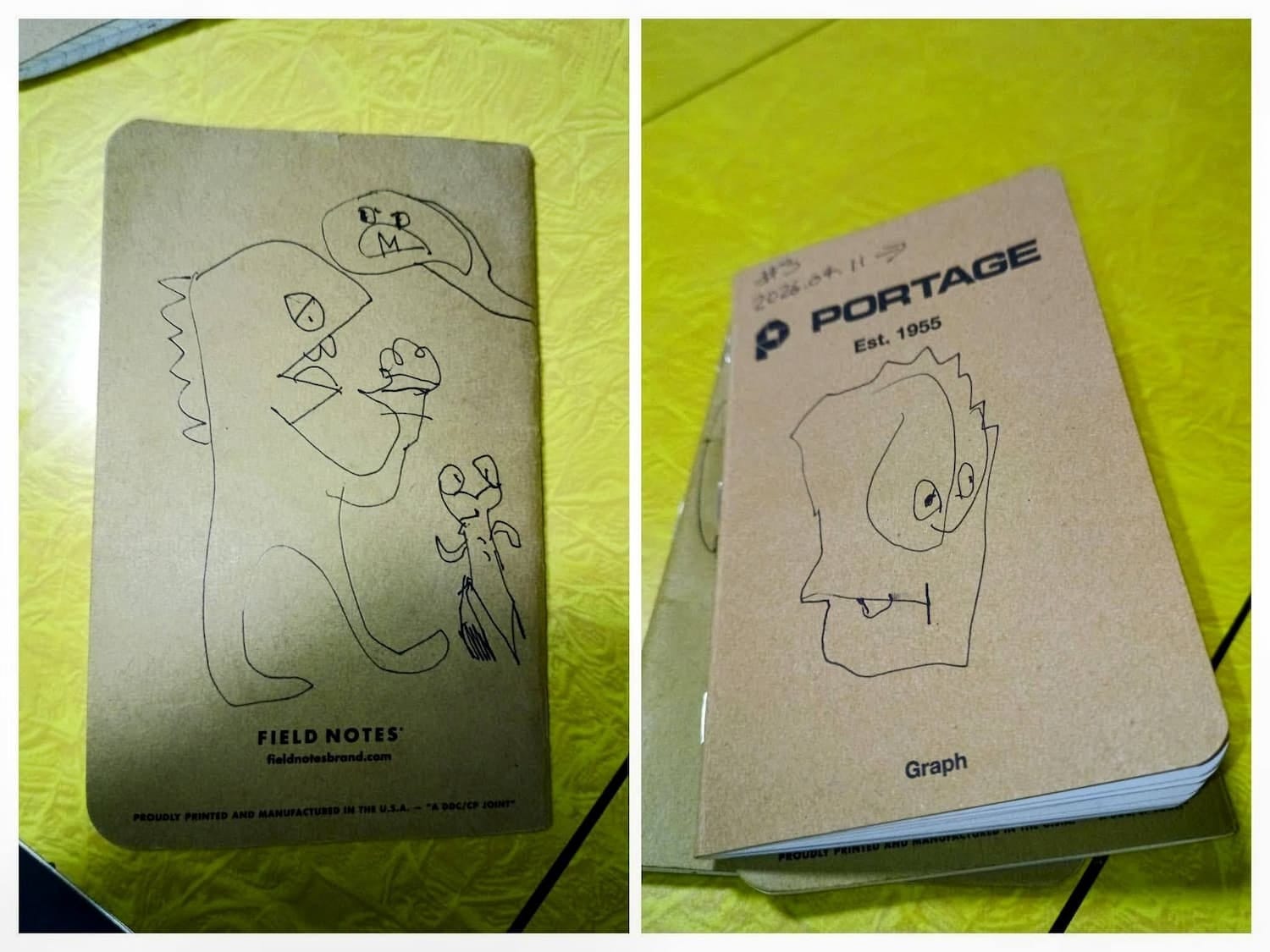
C. Needing to wait somewhere with your kids? Ask them to decorate the cover of your notebook with drawings from their imagination. You will wind up with some awesome artwork you will cherish every time you bring out your notebook and forevermore.
HARDWARE NOTES
NOTEBOOK: Any pocketable notebook will do. The main question to ask yourself when choosing one is, “Will I actually take this with me everywhere I take my phone?” If the answer is “no,” go thinner, cheaper, or smaller. While the FIELD NOTES brand is the standard, I personally dig the PORTAGE brand because you get more pages, more books, and a stiffer cover for less money.
WRITING IMPLEMENTS: My ideal writing implement is (A) something I look forward to using and (B) something I’m not afraid to lose or give away. For this reason, I prefer the uber-smooth, super cheap Pilot Precise V5 RT, though the Uniball Jetstream is a close second. And if someone needs to borrow it and they comment on how much they like it, just give it to them. You may have lost a $3 pen, but you’ve made someone’s day.
My content conduits: